
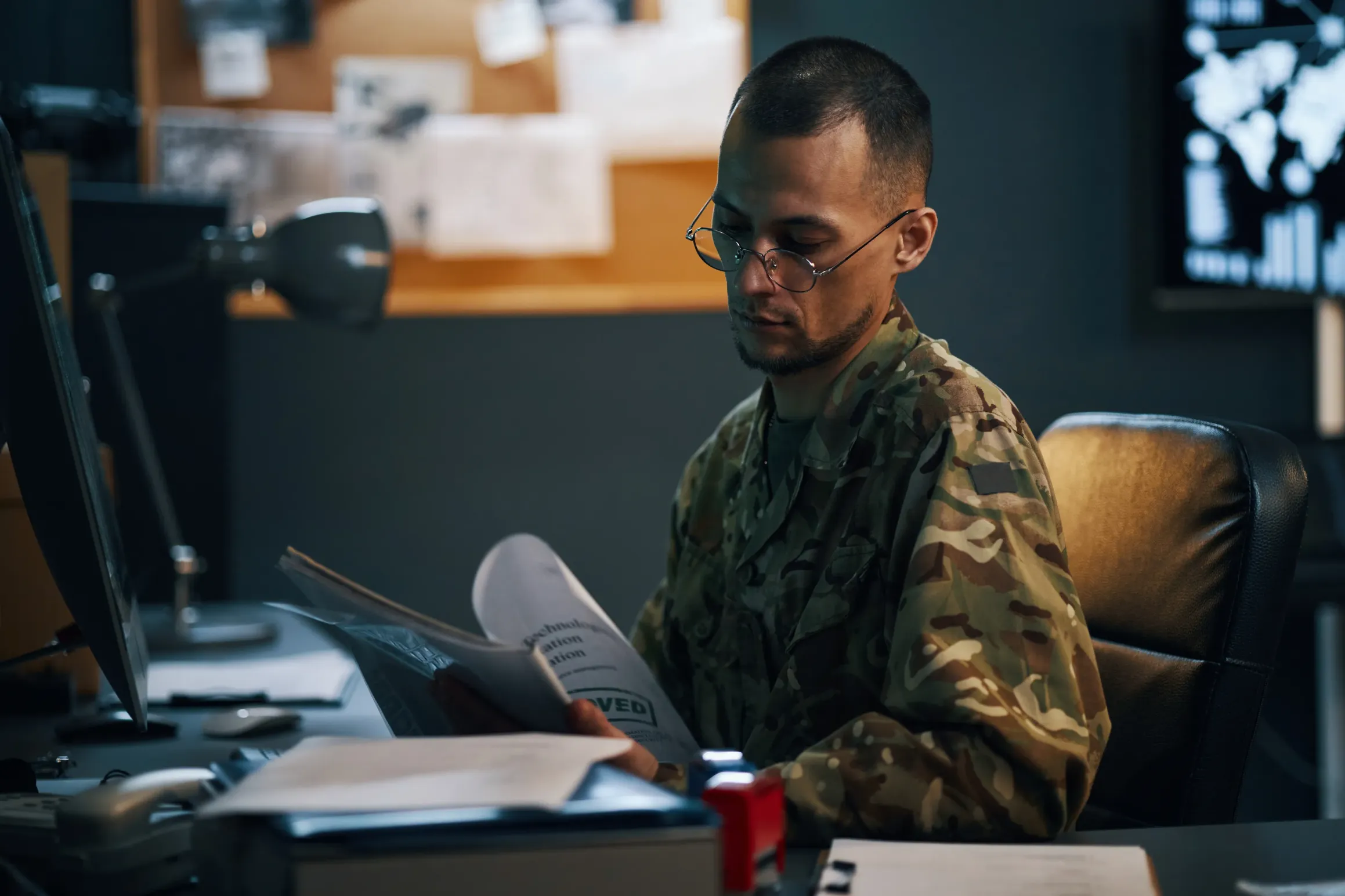
The U.S. military uses three types of courts-martial: summary, special, and general, each with different levels of formality, procedures, and maximum punishments. A summary court-martial resolves minor offenses quickly, a special court-martial works much like a civilian misdemeanor court, and a general court-martial tries the most serious charges a service member can face.
The type of court-martial convened against you shapes nearly everything that follows, from the rights you can exercise to the sentence you could receive. Commanders decide which forum fits the alleged offense, so two service members accused of similar misconduct can end up in very different proceedings, and early military defense guidance can influence that decision before charges are ever referred.
What Is a Summary Court-Martial?
A summary court-martial is the lowest tier of military justice. A single commissioned officer, who does not need to be a lawyer or judge, hears the evidence and decides both guilt and punishment. Only enlisted members can be tried at this level, and you have the right to refuse a summary court-martial.
However, refusal often results in the case being referred to a higher forum, where the available punishments increase considerably. Punishments at this level are capped. For service members in the grade of E-4 and below, the maximum penalties include:
- Confinement for up to 30 days
- Forfeiture of two-thirds pay for one month
- Reduction to the lowest enlisted grade
- Hard labor without confinement for up to 45 days
- Restriction to specified limits for up to 60 days
A conviction at a summary court-martial does not count as a federal criminal conviction, which sharply distinguishes it from the other two forums. Even so, the outcome can damage your record, stall promotions, and influence separation decisions, so the proceeding deserves serious preparation rather than a casual appearance.
Service members in the grades of E-5 and above face slightly different caps, since confinement and hard labor are unavailable against them at this level.
What Is a Special Court-Martial?
A special court-martial is often compared to a civilian misdemeanor trial. A military judge presides, and you can choose trial by a panel of at least four members or by the judge alone. Unlike in the summary forum, a guilty finding here results in a federal conviction that follows you into civilian life.
The jurisdiction and limits of a special court-martial come from 10 U.S.C. § 819, which caps confinement at one year and authorizes forfeiture of two-thirds pay for up to 12 months, reduction in grade, and a bad-conduct discharge for enlisted members. Officers cannot receive a punitive discharge at this level, which is one reason officer cases are frequently referred upward instead.
Because a punitive discharge strips your veterans’ benefits and brands your civilian record, the stakes at a special court-martial run far higher than the “misdemeanor” label suggests. Many service members underestimate the forum and end up paying for it for decades afterward.
What Is a General Court-Martial?
A general court-martial is the military’s felony-level trial court, reserved for offenses such as sexual assault, drug distribution, larceny of government property, and desertion. Its authority comes from 10 U.S.C. § 818, which permits any punishment authorized under the Uniform Code of Military Justice, including a dishonorable discharge, total forfeitures, confinement for life, and, in capital cases, death.
Before a case reaches this level, the government must hold an Article 32 preliminary hearing, a screening proceeding in which a hearing officer reviews the evidence and recommends whether charges should proceed.
The hearing also gives the defense an early look at the government’s case and a chance to lock in witness testimony. The panel at trial consists of at least eight members, and a capital case requires twelve. The accused may also elect to have a military judge try the case alone in non-capital cases.
How Do Commanders Decide Which Court-Martial to Convene?
The convening authority weighs several factors before referring charges to a particular forum. Common considerations include:
- Seriousness of the alleged offense
- Strength of the available evidence
- Prior disciplinary history of the accused
- Recommendations from the chain of command
- Results of any preliminary hearing
These factors interact, and command discretion plays a large part in the outcome. Skilled advocacy during the referral stage can sometimes persuade a convening authority to resolve a case at a lower forum, through nonjudicial punishment, or with no action at all, which makes early intervention one of the most valuable moves available to you.
What Rights Do You Have at a Court-Martial?
In special and general courts-martial, service members are afforded many of the same constitutional protections available in civilian criminal courts, along with certain rights unique to the military justice system.
You also have the option of retaining civilian defense counsel at your own expense, and many service members choose to work with both appointed military counsel and private military defense counsel to gain additional experience, resources, and strategic perspective. The following rights apply in special and general courts-martial:
- The right to remain silent
- The right to free detailed military defense counsel
- The right to cross-examine government witnesses
- The right to present evidence and call witnesses
- The right to appellate review after conviction
Exercising these rights effectively requires planning well before arraignment. Witness lists, expert requests, and suppression motions all carry deadlines, and the choices you make about forum and panel composition can change the trajectory of the entire case.
Acting quickly also preserves favorable evidence, such as text messages, duty logs, and witness recollections, that the government has no obligation to gather on your behalf.
Facing a Court-Martial? Meet With Our Team in Person
Court-martial charges threaten your career, your freedom, and your future benefits, and the right preparation starts long before trial. Unlike most military law firms that operate purely online, O’Connell West, PLLC, meets with clients face to face so that you can sit across the table from the people building your defense.
Call (512) 547-7265 or contact us online to discuss your case with our military defense attorneys in Austin. Our firm represents service members across the state, including Fort Hood, Joint Base San Antonio, Fort Cavazos, Fort Bliss, and Dyess AFB.